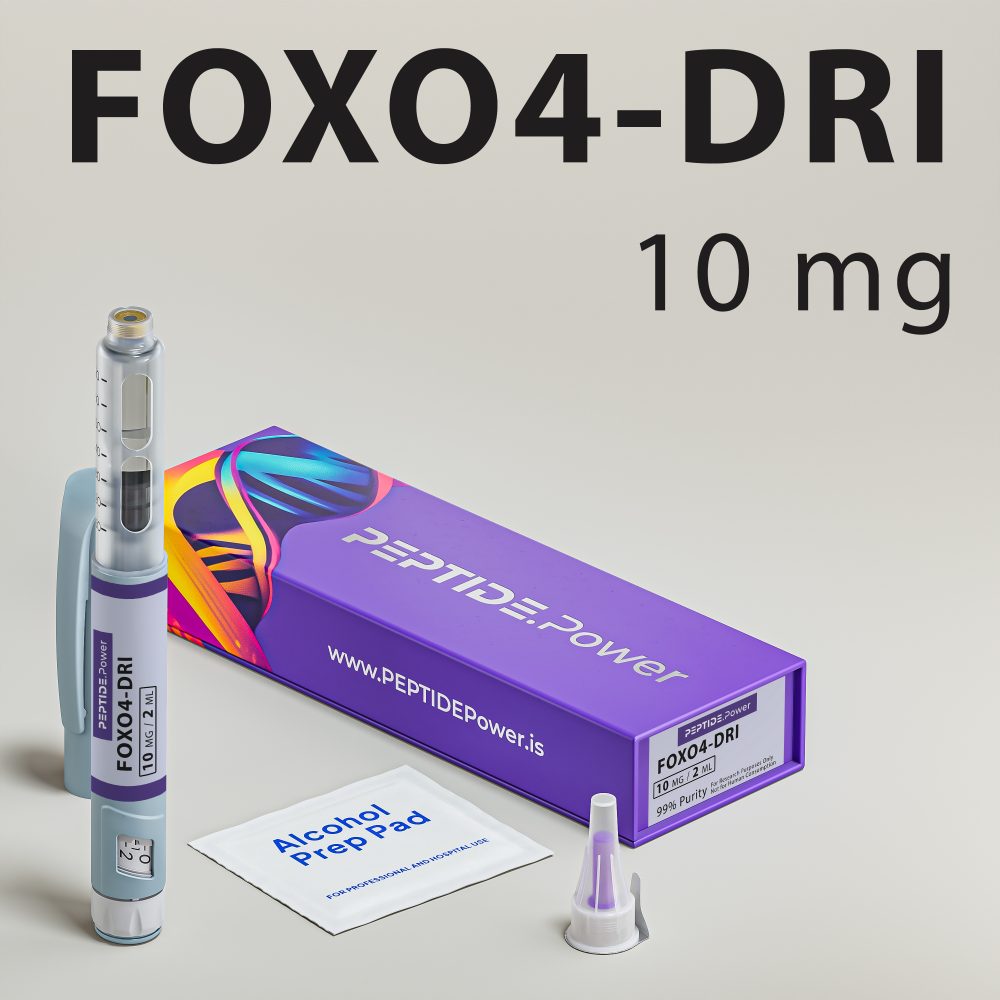


FOXO4-DRI (Proxofim)
FOXO4-DRI (Proxofim) is a synthetic peptide studied for its ability to target senescent cells by disrupting FOXO4–p53 interactions. In preclinical research, this mechanism has been associated with selective apoptosis of senescent cells while preserving healthy cellular populations. FOXO4-DRI is primarily investigated in cellular aging, senescence biology, and longevity-related research contexts. Formulated for research use only.
122,00 €
- Selective Senescent Cell Disruption & Longevity
Description
FOXO4-DRI is a modified peptide designed to interfere with the interaction between FOXO4 and p53, a key protein involved in cellular stress responses. In senescent cells, FOXO4 binds to p53 and prevents apoptosis, allowing these damaged cells to persist. FOXO4-DRI competitively disrupts this interaction, potentially restoring apoptotic signaling specifically in senescent cell populations.
Senescent cells accumulate over time and are characterized by altered gene expression, resistance to apoptosis, and secretion of inflammatory mediators collectively referred to as the senescence-associated secretory phenotype (SASP). FOXO4-DRI has been studied in preclinical models examining selective elimination of these cells.
Research domains include cellular senescence, tissue aging, and experimental longevity models. The peptide is investigated strictly within laboratory and preclinical research environments.
Clinical Status
Human RCT ▣ | Observational ▣ | Animal ✔ | In vitro ✔
Primarily studied in preclinical senescence and longevity research models, with no large-scale human clinical trials.
Mechanism of Action
FOXO4-DRI disrupts the protective interaction between FOXO4 and p53 in senescent cells, allowing damaged cells to undergo apoptosis. This selective interference targets cells that have accumulated stress-related damage while sparing healthy cells.
Benefits
- Disrupts the survival network of senescent cells:
Senescent cells enter a state of permanent growth arrest but resist apoptosis despite accumulating DNA damage and oxidative stress. One of the mechanisms supporting this resistance is the interaction between FOXO4 and p53 within the nucleus. FOXO4-DRI is designed to interfere with this specific protein-protein interaction. By competitively binding FOXO4, it prevents FOXO4 from sequestering p53, thereby restoring the cell’s intrinsic apoptotic signaling capacity. This mechanism does not broadly stimulate cell death but instead targets a survival dependency characteristic of senescent cells. The selectivity of this disruption is central to its senolytic research positioning. - Reactivates p53-driven apoptotic pathways:
p53 is a master regulator of genomic integrity and cellular stress responses. In healthy cells, p53 activation can initiate DNA repair or apoptosis depending on damage severity. In senescent cells, FOXO4 binding limits p53’s pro-apoptotic function. FOXO4-DRI releases p53 from this inhibitory interaction, enabling activation of downstream genes involved in mitochondrial apoptosis pathways. This includes upregulation of pro-apoptotic signaling cascades that restore controlled cellular elimination. The targeted reactivation of p53 distinguishes this peptide from systemic cytotoxic strategies. - Reduces senescence-associated secretory phenotype burden:
Senescent cells secrete inflammatory cytokines, chemokines, growth factors, and proteases collectively referred to as the senescence-associated secretory phenotype (SASP). Persistent SASP signaling contributes to local tissue dysfunction and chronic inflammatory microenvironments in aging models. By eliminating senescent cells in preclinical systems, FOXO4-DRI indirectly reduces the source of SASP factors. This reduction may influence extracellular matrix remodeling, immune cell recruitment, and paracrine signaling in surrounding tissues. The modulation of this inflammatory microenvironment is a central focus in aging research. - Supports investigation of tissue structural rejuvenation:
Accumulated senescent cells can impair tissue architecture by altering cell-to-cell communication and extracellular matrix composition. In animal models, selective removal of these cells has been associated with improved tissue morphology and regenerative capacity. FOXO4-DRI is studied within this context to examine how targeted senolysis influences organ-level structure. Rather than promoting growth directly, it aims to clear dysfunctional cellular components that impede normal tissue renewal processes. - Engages FOXO transcription factor signaling networks:
FOXO transcription factors regulate oxidative stress resistance, metabolic adaptation, and longevity-associated gene expression. FOXO4-DRI interacts within this broader signaling network by selectively targeting FOXO4-mediated survival mechanisms. While its primary action involves p53 release, the modulation of FOXO4-related pathways intersects with cellular stress-response systems. This positions FOXO4-DRI within advanced molecular longevity research rather than endocrine or metabolic peptide categories. - Selective senolytic mechanism distinct from broad cytotoxic agents:
Traditional cytotoxic compounds induce apoptosis in proliferating cells without discrimination. FOXO4-DRI, in contrast, exploits a molecular dependency unique to senescent cells. Because healthy proliferating cells do not rely on sustained FOXO4–p53 sequestration for survival, they are less affected in experimental models. This selective targeting strategy represents a precision-based approach to senolysis, focusing on restoring intrinsic apoptosis rather than inducing external stress. - Facilitates research into biological aging pathways:
Cellular senescence is considered one of the hallmarks of aging. Accumulation of senescent cells is associated with reduced regenerative potential and altered tissue homeostasis. FOXO4-DRI is studied in preclinical longevity models to evaluate how senescent cell clearance influences biological aging markers. This includes assessment of tissue resilience, inflammatory signaling, and regenerative capacity at the cellular level. - Operates at the nuclear protein-interaction level:
Unlike metabolic or hormonal peptides that act on membrane receptors, FOXO4-DRI functions by disrupting nuclear protein interactions. Its D-retro-inverso configuration enhances stability while maintaining structural mimicry necessary for competitive inhibition. This intracellular mechanism differentiates it from peptides that stimulate systemic signaling cascades. Its activity is centered on modifying cell fate decisions within damaged cellular populations. - Contributes to experimental cellular turnover modeling:
By enabling removal of senescent cells, FOXO4-DRI supports investigation into how cellular turnover influences tissue equilibrium. The balance between senescence, apoptosis, and regeneration is central to maintaining organ function. Studying this dynamic allows researchers to explore how selective senolysis impacts long-term structural adaptation in aging models. This makes FOXO4-DRI relevant within high-level cellular systems research rather than traditional hormone modulation frameworks.
Research Data
xxx
Stack Suggestions
xxx
Pen Dosage Chart
Dosage & Protocols Variations
xxx
Possible Side Effects
xxx
Product Attributes
xxx
Scientific References
xxx
Included In The Box
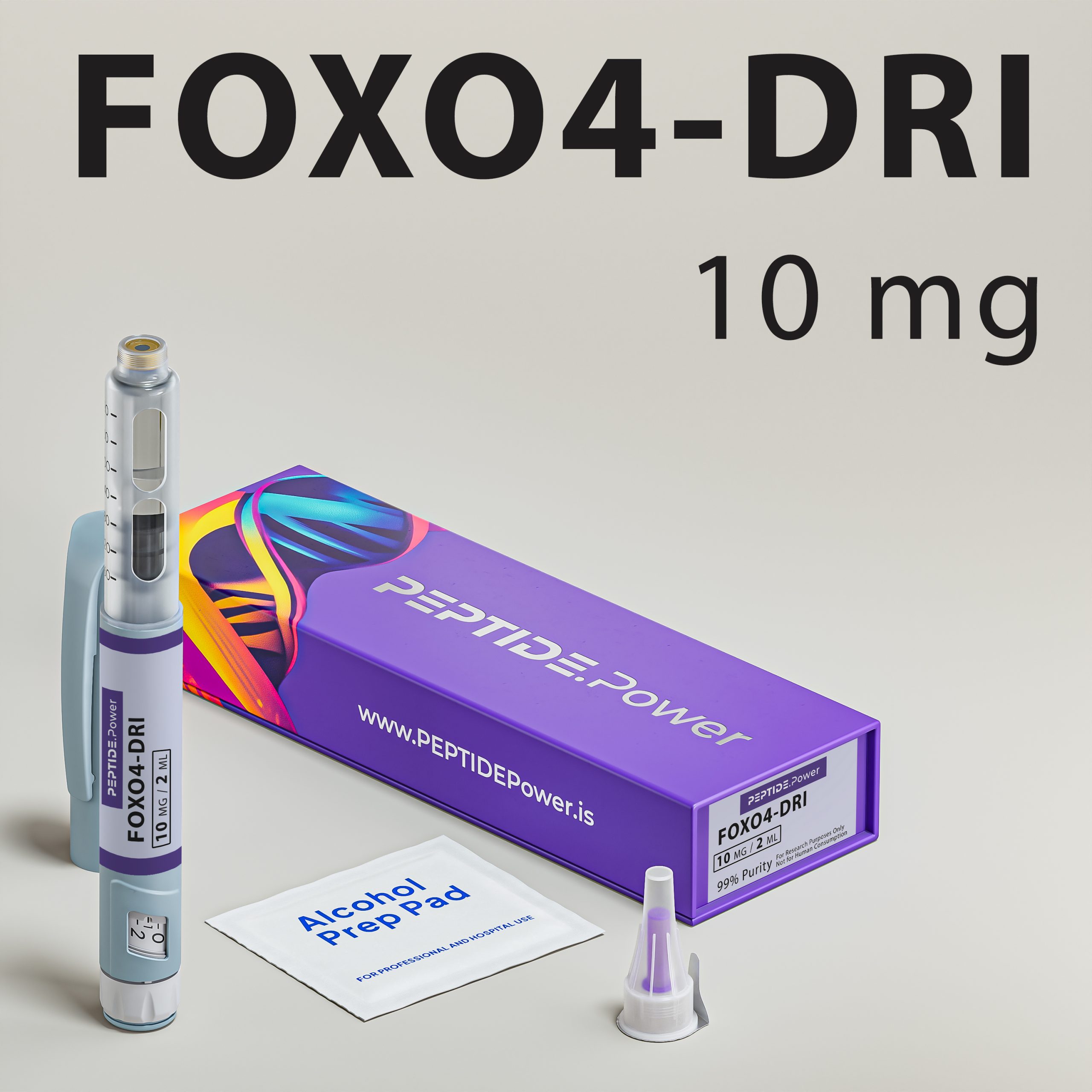
Every product arrives in a premium, custom-designed PEPTIDE.Power box, engineered for convenience, hygiene, and safe storage in your refrigerator. Inside, you will find everything needed for your full research protocol:
- 1× Disposable Pre-Mixed Injection Pen
- Powered by our proprietary PSM Technology™ – precision stabilization & mixing system for consistent potency
- 10× Ultra-thin Needles (33G, 4 mm)
- 10× Alcohol Pads for sterile preparation
- Internal Stabilizing Foam Insert to prevent shaking during transport
- Instruction Panel printed on the inside of the box for quick reference
- Security Seal Sticker ensuring the package has not been opened or tampered with
Storage
Store the product in a refrigerator at 1 – 7°C immediately upon delivery. To maintain optimal stability, keep the pen away from light, and do not expose it to repeated temperature changes.
Once reconstituted (all our pens come pre-mixed), research compounds remain stable for 6 – 8 weeks under proper refrigeration.
Do not freeze after reconstitution. Always keep the box closed so the pen, needles, and alcohol pads stay clean and protected.
For best results, use the product consistently within the recommended time window and always follow your research protocol.
Delivery
We ship with Next-Day EU Delivery via DHL Express or UPS Express.
All orders are prepared fresh on the day of dispatch, placed in EPS cold-chain transport boxes, and shipped with cooling elements to maintain a stable temperature throughout the journey.
Our logistics process is designed so the package arrives overnight, avoiding customs delays inside the European Union.
Products are shipped from our EU facility, ensuring no import duties, no customs clearance, and always fast and secure delivery.
Payment
Due to the nature of research peptides and the high-risk category assigned by payment processors, credit card companies do not support merchants in this field.
For this reason, we accept bank transfers only.
Within the European Union, SEPA transfers are fast, low-cost, and usually arrive within minutes to a few hours, making the payment process smooth and simple.
Once the transfer is received, your order is prepared immediately and dispatched the same day (cut-off dependent).
This method ensures compliance, security, and continuity of service for all customers across the EU.
RELATED PRODUCTS

DSIP

GLP-1S

Kisspeptin

LL-37