

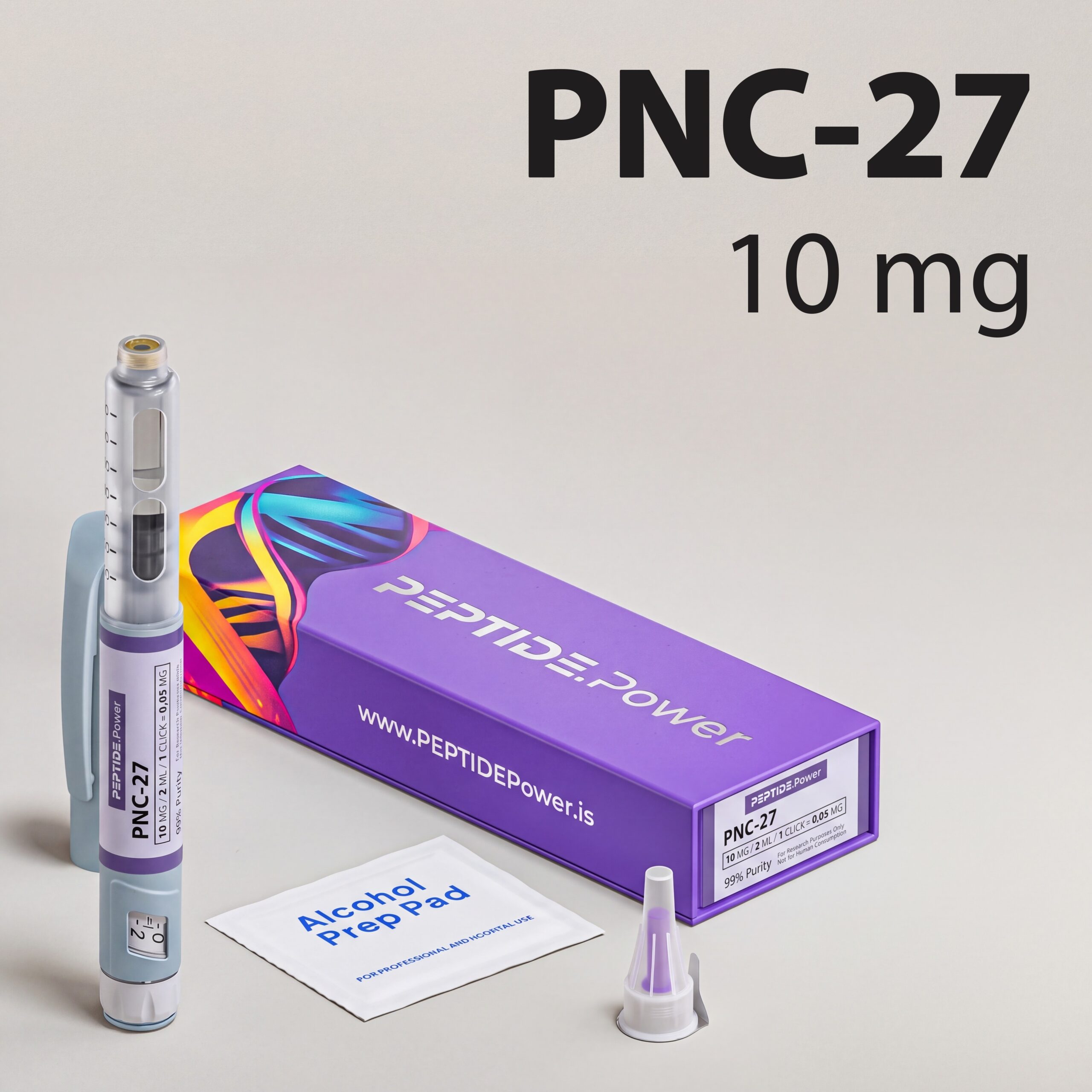


PNC-27
PNC-27 is a synthetic chimeric peptide composed of the p53(12-26) transactivation fragment fused to a membrane-residency sequence (MRP) derived from penetratin. It has been investigated in vitro for its interaction with HDM-2 (MDM2) and its membrane-pore formation in cultured cell lines expressing membrane-associated HDM-2. Suitable for experimental models focused on membrane biology, peptide conformation, and p53 pathway studies.
122,00 €
PNC-27 - Chimeric p53-Derived Research Peptide
The p53(12-26) segment is reported to anchor PNC-27 to HDM-2-presenting membranes in vitro
Research models have observed pore-like structures forming in lipid bilayers of HDM-2-expressing cultured lines
The fused MRP domain appears to facilitate chimeric peptide insertion into plasma membrane bilayers in vitro
Studied as a design model fusing p53 transactivation residues with a penetratin membrane-residency sequence
Time-course experiments report membrane permeabilization within minutes to hours of in vitro exposure
Co-culture studies suggest peptide localization tracks with surface HDM-2 presentation across mixed populations
Evaluated across several cultured cell line models as a membrane-interaction reference tool
In vitro work has examined PNC-27 interactions with mitochondrial membranes where HDM-2 may also localize
Description
PNC-27 is a chimeric synthetic peptide composed of a 15-residue segment from the HDM-2 (MDM2) binding domain of p53 (residues 12-26) fused to a membrane-residency peptide (MRP) derived from penetratin. This structural design is studied in vitro for its interaction with membrane-associated HDM-2 and its influence on lipid bilayer organization in cultured cell lines that express HDM-2 at the plasma membrane.
In experimental in vitro research, PNC-27 has been observed to interact with the plasma membrane of cultured cell lines that display HDM-2 at the membrane surface, where the MRP segment anchors the peptide and supports transmembrane pore formation. Studies have characterized these membrane interactions across several cultured cell line models.
Mechanistic investigations have also explored PNC-27’s influence on membrane cholesterol organization and its conformational behavior at lipid interfaces, distinguishing its membrane-residency design from classical intracellular p53-derived peptides.
Supplied as a ready-to-use injection pen (2 mL solution, 1 click = 0.01 mL) at >98% HPLC purity, PNC-27 is intended for laboratory handling and in vitro assays only; no research dosing protocol is published and no dose is recommended (see the Dosage section).
Clinical Status:
PNC-27 is a research peptide investigated exclusively in preclinical in vitro studies of HDM-2 binding and membrane pore formation. It is not approved for medical use and remains restricted to laboratory and experimental research.
Evidence type:
Human RCT ☐ | Observational ☐ | Animal ✔ | In vitro ✔ | Regulatory ☐
Mechanism of Action
PNC-27 is a chimeric peptide that fuses the HDM-2 binding domain of p53 (residues 12-26) with a membrane-residency peptide (MRP) transporter sequence derived from penetratin. In research models, the MRP segment enables the construct to localize to cellular membranes, while the p53-derived segment is studied for its interaction with HDM-2. In vitro investigations have reported membrane pore formation in cultured cell lines expressing membrane-associated HDM-2, alongside structural and conformational studies of the p53 N-terminal domain.
Benefits
- Membrane Pore Formation in HDM-2-Expressing Cell Lines:
PNC-27 has been investigated in vitro for its ability to interact with the plasma membrane of cultured cell lines that express HDM-2 on their surface. Research models have observed pore-like structures forming in the lipid bilayer under these conditions. This membrane-interaction profile has made PNC-27 a focal compound in laboratory research exploring targeted peptide-membrane behavior. - HDM-2 Binding Interaction:
The p53-derived segment of PNC-27 is studied for its binding affinity to HDM-2 (human double minute-2 protein), a regulator reported on the surface of certain cultured cell lines. In vitro experiments have shown that this interaction anchors the peptide to HDM-2-presenting membranes, providing a mechanistic basis for the binding and membrane-residency observations reported in research settings. - Co-Culture Membrane Interaction Studies:
Laboratory studies using mixed cell populations have characterized how PNC-27 associates with membranes depending on surface HDM-2 presentation. These in vitro observations have positioned PNC-27 as a reference compound for studying targeted peptide-membrane docking and the role of surface receptor expression in guiding peptide localization in cultured systems. - Penetratin-Mediated Membrane Translocation:
The penetratin (MRP) domain fused to the p53 sequence enhances the peptide’s interaction with lipid bilayers. In vitro research has characterized how this cell-penetrating motif facilitates insertion into the plasma membrane, enabling the chimeric construct to engage its molecular target efficiently. This design has informed broader research into chimeric peptide architecture and membrane-active research compounds. - Rapid Onset of Membrane Permeabilization in Vitro:
Time-course experiments in cultured HDM-2-expressing cell lines have observed membrane permeabilization occurring within minutes to hours of PNC-27 exposure, distinguishing it from slower-acting signaling-dependent agents. This kinetic profile has made PNC-27 useful in research models comparing membrane-targeted versus signaling-mediated mechanisms and in studies of acute peptide-bilayer interactions. - Investigated Interaction Across Multiple Cultured Cell Lines:
PNC-27 has been evaluated in a range of cultured cell line research models. In vitro observations have reported membrane-interaction responses across these diverse cultured phenotypes, correlating with surface HDM-2 expression levels. This breadth of experimental data has positioned PNC-27 as a reference tool compound in membrane-targeted peptide research. - Mitochondrial Membrane Interaction:
Beyond plasma membrane effects, in vitro research has also examined PNC-27 interactions with mitochondrial membranes in cultured cells, where HDM-2 may also localize. Observed changes in mitochondrial membrane integrity contribute to the overall membrane-interaction profile and offer researchers an additional endpoint for studying membrane-targeted peptide mechanisms and bioenergetic readouts in cultured cell models. - Research Tool for Chimeric Peptide Design:
As a well-characterized chimeric construct combining a p53(12-26) targeting sequence with a cell-penetrating peptide, PNC-27 serves as a template in laboratory research on modular peptide engineering. Studies have used it to explore how targeting domains and translocation motifs can be combined to influence membrane localization, informing the broader field of peptide-based research probes and experimental delivery systems.
Research Data
| Study / Model | Reported effect |
|---|---|
| Cultured cell line models (in vitro) | Membrane interaction and pore formation observed in cultured cells expressing membrane-associated HDM-2 |
| HDM-2 binding assays (in vitro) | Direct interaction with membrane-associated HDM-2, consistent with the p53(12-26)-MRP chimeric design |
| Structural and conformation studies | Characterization of penetratin/MRP membrane-residency sequence and peptide conformation at lipid interfaces |
Stack Suggestions
PNC-27 is often combined in research with:
- PNC-27 + Epitalon → Pairs membrane-interaction research with telomerase and cellular aging pathway studies.
- PNC-27 + Thymalin → Combines p53-derived membrane binding models with immunomodulatory research frameworks.
- PNC-27 + SS-31 → Explores mitochondrial membrane studies alongside HDM-2 membrane-interaction observations in cultured cell models.
- PNC-27 + GHK-Cu → Investigates peptide-membrane interactions in parallel with extracellular matrix signaling in cytological research.
⚠ Stacks are for experimental design only; not safety or efficacy guidance.
Pen Dosage Chart
| PNC-27 Pen 10 mg | |
|---|---|
| Volume | 2 mL |
| mg/mL | 5 mg/mL |
| Click-to-Dose | 1 click = 0.05 mg |
| Example(s) | 10 clicks = 0.5 mg |
Dosage & Protocols Variations
No established research dosing protocol has been published for PNC-27. It is supplied as a reference material for laboratory research only and no dose is recommended; the table above shows only how the pen volume converts to milligrams.
Possible Side Effects
PNC-27 is a research-only chimeric peptide investigated almost exclusively in in vitro cell culture systems, with limited in vivo rodent data. No human clinical safety data are available.
Observations reported in preclinical and laboratory studies include:
- Non-selective membrane interaction and pore-formation observations at elevated concentrations in cultured cell lines.
- Membrane-perturbation signals reported across various cultured cell lines in some in vitro models when exposure exceeds experimental thresholds.
- Transient membrane-permeabilization signals observed in isolated erythrocyte assays at high peptide concentrations.
- Local inflammatory response reported in limited rodent injection-site evaluations.
- Aggregation or precipitation in aqueous buffers, potentially affecting experimental reproducibility.
No evidence of systemic, hormonal, or organ-specific adverse effects has been established in available data. PNC-27 is strictly for laboratory research use and is not approved for human or veterinary application.
Product Attributes
- CAS #: 1159861-00-3
- Molecular Formula: C188H293N53O44S
- Sequence (AA): PPLSQETFSDLWKLLKKWKMRRNQFWVKVQRG
- Molecular Weight: ~4031.8 g/mol
- PubChem CID: 16201774
- Half-Life: N/A (not established)
- Synonyms: PNC-27 acetate, p53(12-26)-penetratin chimeric peptide, p53(12-26)-MRP
- Type: Synthetic research peptide (chimeric p53-derived peptide)
- Research Focus: Chimeric p53(12-26)-MRP peptide studied in vitro for HDM-2 binding and membrane interactions; for laboratory research only
Scientific References
- Sarafraz-Yazdi E et al. Biomedicines 2022 In vitro
- Sarafraz-Yazdi E et al. Proc Natl Acad Sci U S A 2010 In vitro
- Kanovsky M et al. Proc Natl Acad Sci U S A 2001 In vitro
- Electronic structure and physicochemical properties characterization of the amino acids 12-26 of TP53: a theoretical study In silico
- Structural details on mdm2-p53 interaction In vitro
- Membrane interaction and cellular internalization of penetratin peptides In vitro
- Rosal R et al. Biochemistry 2004 In vitro
- PubChem CID 16201774 Registry
Included In The Box
Every product arrives in a premium, custom-designed PEPTIDE.Power box, engineered for convenience, hygiene, and safe storage in your refrigerator. Inside, you will find everything needed for your full research protocol:
- 1× Disposable Pre-Mixed Injection Pen
- Powered by our proprietary PSM Technology™: precision stabilization & mixing system for consistent potency
- 10× Ultra-thin Needles (33G, 4 mm)
- 10× Alcohol Pads for sterile preparation
- Internal Stabilizing Foam Insert to prevent shaking during transport
- Instruction Panel printed on the inside of the box for quick reference
- Security Seal Sticker ensuring the package has not been opened or tampered with
Storage
Store the product in a refrigerator at 1-8°C immediately upon delivery. To maintain optimal stability, keep the pen away from light, and do not expose it to repeated temperature changes.
Once reconstituted (all our pens come pre-mixed), research compounds remain stable for 6-8 weeks under proper refrigeration.
Do not freeze after reconstitution. Always keep the box closed so the pen, needles, and alcohol pads stay clean and protected.
For best results, use the product consistently within the recommended time window and always follow your research protocol.
Delivery
We ship with Next-Day EU Delivery via DHL Express or UPS Express.
All orders are prepared fresh on the day of dispatch, placed in EPS Cold-Chain Transport Boxes, and shipped with cooling elements to maintain a stable temperature throughout the journey.
Our logistics process is designed so the package arrives overnight, avoiding customs delays inside the European Union.
Products are shipped from our EU facility, ensuring no import duties, no customs clearance, and always fast and secure delivery.
Payment
Due to the nature of research peptides and the high-risk category assigned by payment processors, credit card companies do not generally support merchants in this field.
For this reason, we accept mainly Bank Transfers.
We also work with a crypto payment provider, and from time to time, card payments may be available depending on processor availability.
Within the European Union, SEPA transfers are fast, low-cost, and usually arrive within minutes to a few hours, making the payment process smooth and simple.
Once the transfer is received, your order is prepared immediately and dispatched the same day, depending on the daily cut-off time.
Please note that we do not dispatch shipments on Fridays or on days before official public holidays. This is done to ensure that parcels can be delivered on the next working day and are not held in transit over weekends or holidays.
This method ensures compliance, security, and continuity of service for all customers across the EU.
Didn't find the answer to your question?
View all frequently asked questionsRELATED PRODUCTS


HCG (Choriomon)


IGF-1LR3


Mazdutide


MOTS-c


