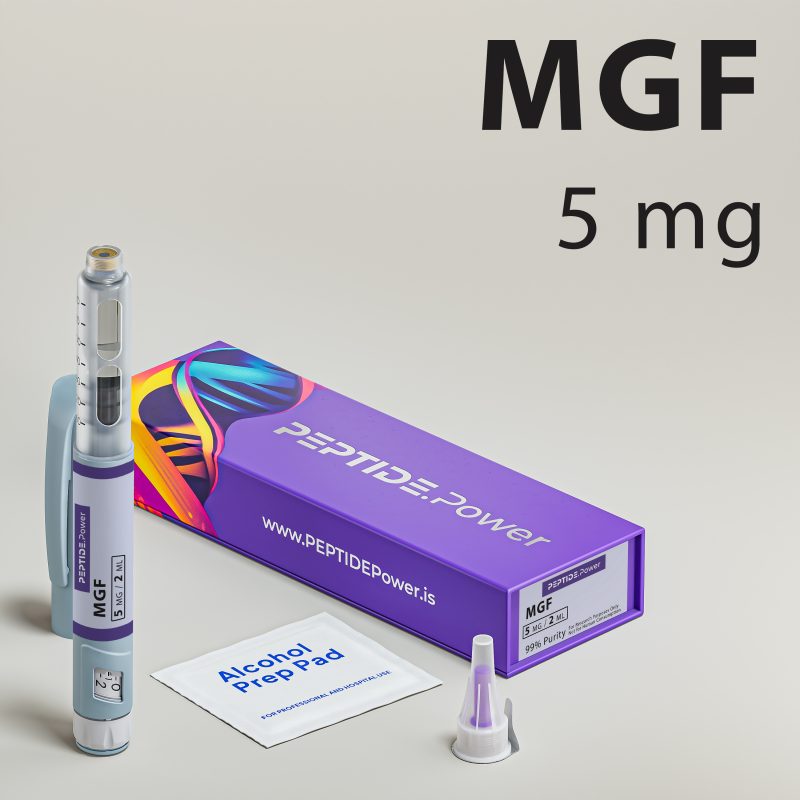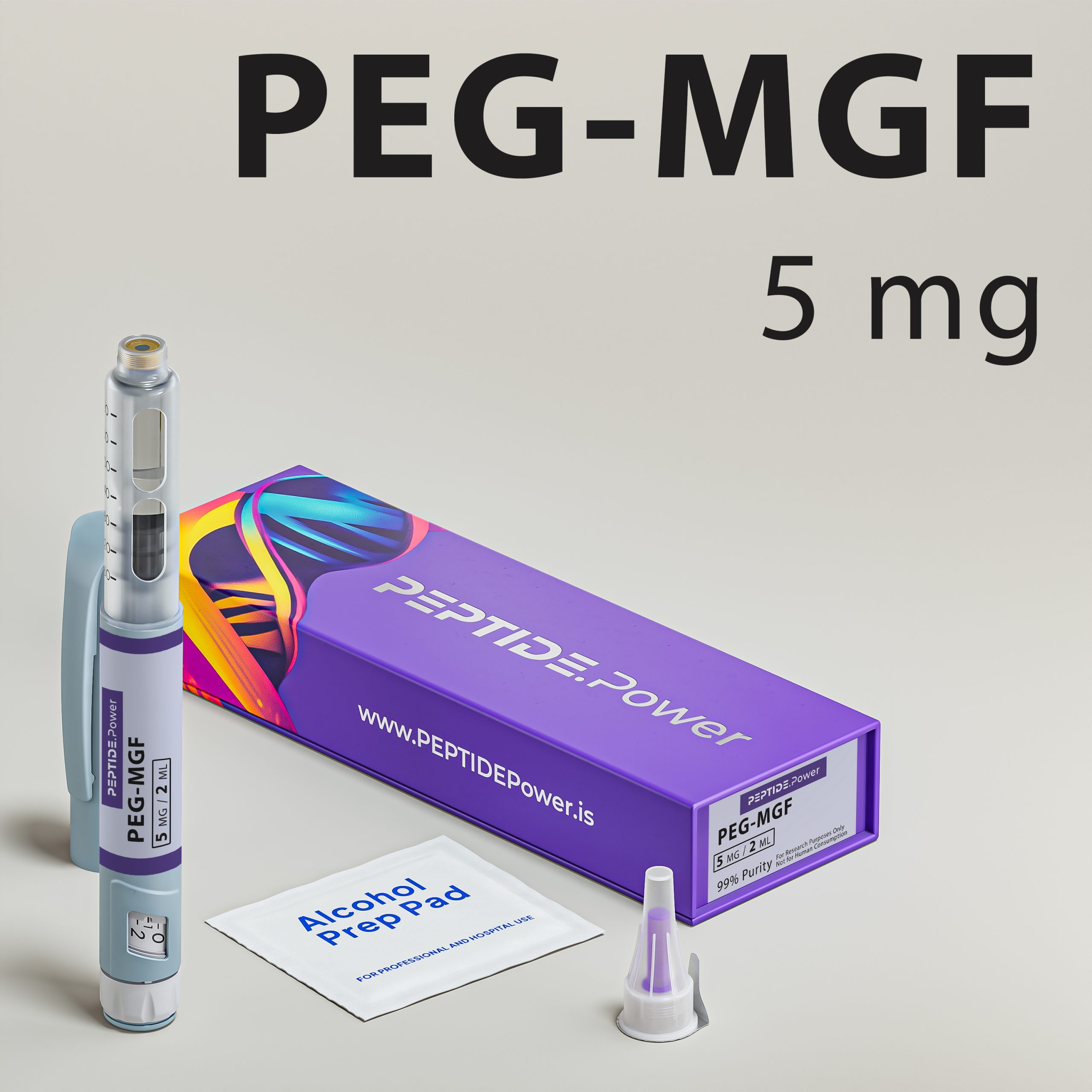


PEG-MGF
PEG-MGF is a pegylated analog of Mechano Growth Factor, a splice variant of IGF-1 studied for its role in muscle repair and satellite cell activation. In preclinical research, it has been observed to influence local anabolic signaling following mechanical stress. PEGylation extends its half-life, supporting prolonged IGF-1 pathway modulation in experimental models. Formulated in a stabilized pre-mixed injection pen for research use only.
77,00 €
- Muscle Repair & IGF-1 Signaling Modulator
Description
PEG-MGF is a PEGylated synthetic analog of Mechano Growth Factor, a naturally occurring splice variant of insulin-like growth factor 1 (IGF-1) expressed in response to mechanical muscle stress. It belongs to the class of growth factor–related peptides primarily studied in muscle regeneration, hypertrophy signaling, and recovery biology. MGF differs structurally from IGF-1 LR3 and native IGF-1 by its unique E-domain sequence, which is associated with local tissue repair signaling rather than systemic growth effects.
PEGylation increases molecular stability and circulation time → ↑ half-life and prolonged receptor interaction in research models. Our formulation is provided in a stabilized pre-mixed injection pen for SubQ administration. Subcutaneous delivery supports consistent systemic exposure and predictable pharmacokinetics in experimental protocols. Each unit is freshly prepared and intended strictly for research use only.
In preclinical models, PEG-MGF has been observed to activate satellite cell proliferation → ↑ muscle repair signaling following mechanical overload. It interacts with IGF-1 receptor pathways and downstream PI3K/Akt signaling cascades → ↑ protein synthesis and cellular growth responses. Animal studies demonstrate localized anabolic signaling rather than widespread systemic IGF-1 elevation. Evidence type: Animal ▣ | In vitro ▣; limited human exploratory data.
Clinical Status
Human RCT ▣ | Observational ▣ | Animal ✔ | In vitro ✔
Primarily studied in preclinical muscle regeneration and satellite cell activation research contexts.
Mechanism of Action
PEG-MGF supports localized muscle repair signaling by mimicking the naturally occurring Mechano Growth Factor produced after mechanical stress. It influences satellite cell activation and promotes intracellular pathways associated with protein synthesis and tissue regeneration. The pegylated structure prolongs peptide stability, allowing sustained engagement with repair-related signaling mechanisms in experimental models.
Benefits
- Satellite Cell Activation And Early-Phase Regeneration:
PEG-MGF has been studied for its ability to stimulate satellite cells, the resident stem cells responsible for muscle regeneration. Following mechanical overload, endogenous MGF expression increases locally within muscle tissue. PEG-MGF mimics this response, supporting activation of quiescent precursor cells. These cells proliferate and differentiate into new myofibers, contributing to structural repair. Laboratory models demonstrate increased expression of early myogenic transcription factors during this phase. This early-stage regenerative activation distinguishes PEG-MGF from peptides primarily associated with late-stage hypertrophy. - Intracellular Anabolic Signaling Modulation:
Activation of IGF-1 receptor–associated pathways influences intracellular signaling networks governing protein synthesis. PI3K and Akt phosphorylation play central roles in regulating mTOR activity, a key controller of ribosomal biogenesis. PEG-MGF has been observed to support these pathways in controlled models. Enhanced translation initiation and structural protein assembly contribute to muscle fiber repair. Unlike systemic growth hormone stimulation, this activity appears localized to mechanically stressed tissue. - Localized Adaptation To Mechanical Stress:
Mechano Growth Factor is naturally expressed in response to resistance exercise and tissue strain. PEG-MGF is designed to replicate this localized biological response. Preclinical studies suggest improved structural organization of regenerating muscle fibers in overload models. This targeted adaptation aligns with tissue-specific remodeling rather than generalized endocrine stimulation. The localized mechanism reduces broad systemic growth signaling. - Enhanced Structural Muscle Remodeling:
In injury-based experimental systems, PEG-MGF has been associated with improved alignment and maturation of regenerating fibers. Increased cross-sectional fiber area has been observed in controlled settings. Structural remodeling is coordinated by regulated gene expression and satellite cell differentiation. This contributes to functional recovery in laboratory models of muscle damage. - Extended Biological Stability Through PEGylation:
Native MGF peptides degrade rapidly in circulation due to enzymatic breakdown. PEGylation increases molecular size and steric protection, improving resistance to proteolysis. This modification extends peptide half-life and maintains receptor interaction over longer periods. The improved pharmacokinetic profile enhances reproducibility in structured research protocols. - Regulation Of Myogenic Gene Expression:
Research indicates increased transcription of regulatory factors involved in muscle differentiation. MyoD, myogenin, and other satellite cell–associated genes are involved in coordinated repair signaling. PEG-MGF supports this transcriptional environment in experimental models. These molecular changes underlie visible structural regeneration in muscle tissue. - Potential Influence On Fibrotic Remodeling Balance:
Optimized regenerative signaling may influence how muscle tissue reorganizes after injury. Some experimental observations suggest improved collagen organization in regenerating fibers. Balanced remodeling is essential to functional tissue restoration. These findings remain within controlled research contexts but contribute to its inclusion in regeneration-focused protocols. - Controlled Subcutaneous Delivery For Research Protocols:
Provided in a stabilized pre-mixed injection pen for SubQ administration, PEG-MGF supports consistent absorption characteristics in experimental settings. Subcutaneous delivery allows predictable exposure and structured dosing. Each unit is freshly prepared and intended strictly for laboratory use only.
Research Data
xxx
Stack Suggestions
xxx
Pen Dosage Chart
Dosage & Protocols Variations
xxx
Possible Side Effects
xxx
Product Attributes
xxx
Scientific References
xxx
Included In The Box
Every product arrives in a premium, custom-designed PEPTIDE.Power box, engineered for convenience, hygiene, and safe storage in your refrigerator. Inside, you will find everything needed for your full research protocol:
- 1× Disposable Pre-Mixed Injection Pen
- Powered by our proprietary PSM Technology™ – precision stabilization & mixing system for consistent potency
- 10× Ultra-thin Needles (33G, 4 mm)
- 10× Alcohol Pads for sterile preparation
- Internal Stabilizing Foam Insert to prevent shaking during transport
- Instruction Panel printed on the inside of the box for quick reference
- Security Seal Sticker ensuring the package has not been opened or tampered with
Storage
Store the product in a refrigerator at 1 – 7°C immediately upon delivery. To maintain optimal stability, keep the pen away from light, and do not expose it to repeated temperature changes.
Once reconstituted (all our pens come pre-mixed), research compounds remain stable for 6 – 8 weeks under proper refrigeration.
Do not freeze after reconstitution. Always keep the box closed so the pen, needles, and alcohol pads stay clean and protected.
For best results, use the product consistently within the recommended time window and always follow your research protocol.
Delivery
We ship with Next-Day EU Delivery via DHL Express or UPS Express.
All orders are prepared fresh on the day of dispatch, placed in EPS cold-chain transport boxes, and shipped with cooling elements to maintain a stable temperature throughout the journey.
Our logistics process is designed so the package arrives overnight, avoiding customs delays inside the European Union.
Products are shipped from our EU facility, ensuring no import duties, no customs clearance, and always fast and secure delivery.
Payment
Due to the nature of research peptides and the high-risk category assigned by payment processors, credit card companies do not support merchants in this field.
For this reason, we accept bank transfers only.
Within the European Union, SEPA transfers are fast, low-cost, and usually arrive within minutes to a few hours, making the payment process smooth and simple.
Once the transfer is received, your order is prepared immediately and dispatched the same day (cut-off dependent).
This method ensures compliance, security, and continuity of service for all customers across the EU.
RELATED PRODUCTS

CJC 1295 (No DAC)

GHK-Cu

GHRP-6

Melanotan I