


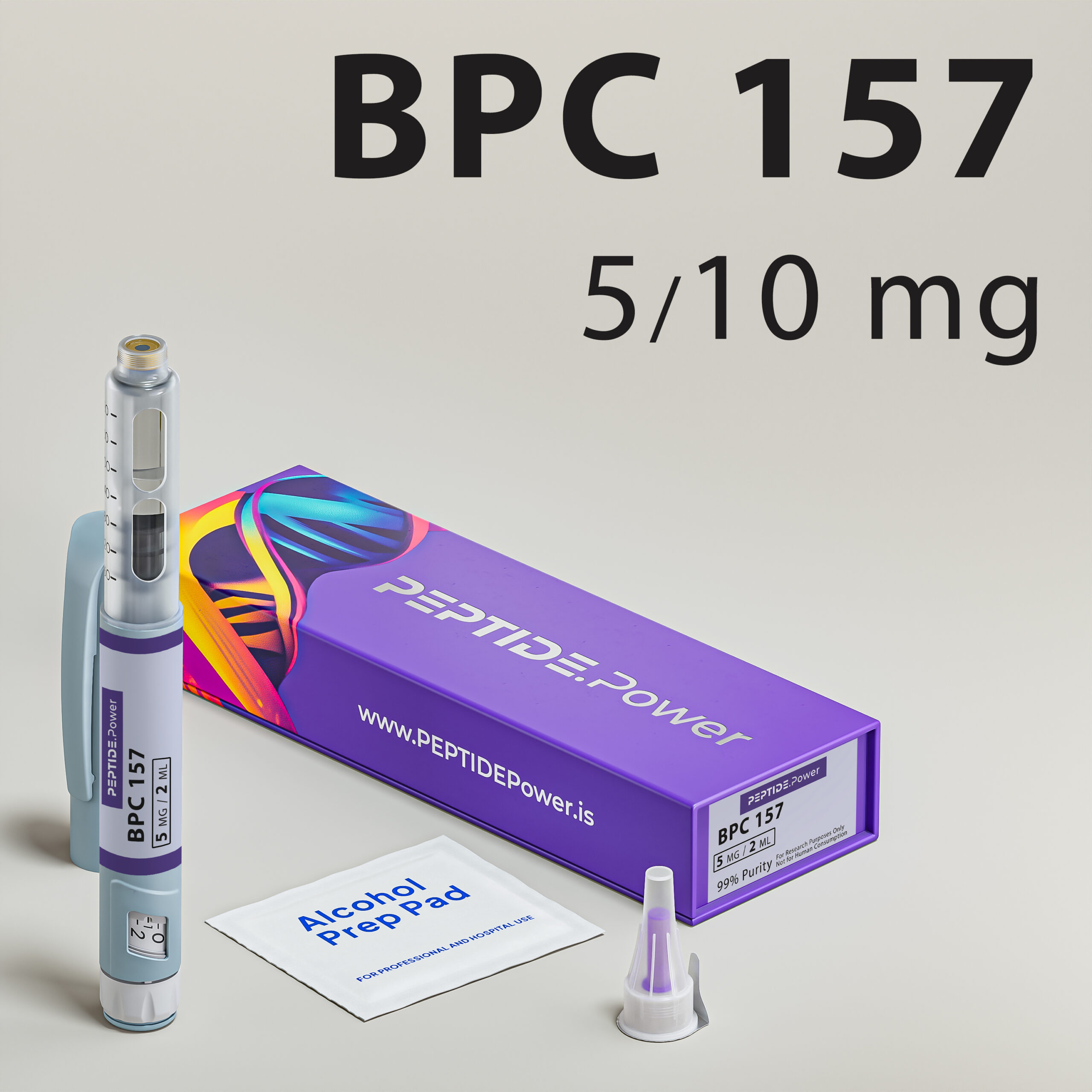


BPC-157
BPC-157 is a synthetic pentadecapeptide derived from human gastric juice, extensively studied for its regenerative properties in animal models. It has been observed to promote tissue repair in tendons, ligaments, muscles, and other organs. Suitable for experimental models focused on recovery, inflammation modulation, and wound healing.
61,00 € – 103,00 €Price range: 61,00 € through 103,00 €
- Recovery & Regeneration Research Peptide
Description
BPC-157 is a synthetic peptide fragment derived from human gastric juice, composed of 15 amino acids and known for its broad regenerative and cytoprotective properties. It is studied for its ability to promote tissue repair, angiogenesis, and cellular healing across multiple organ systems, including muscle, tendon, nerve, and gastrointestinal tissue.
In experimental models, BPC-157 has been observed to accelerate wound healing, stimulate collagen synthesis, and enhance angiogenesis through upregulation of growth factors such as VEGF and modulation of the FAK-paxillin signaling pathway. These effects lead to faster recovery and improved structural integrity following injury, making it one of the most researched compounds in tissue regeneration and recovery science.
BPC-157 also exerts anti-inflammatory and antioxidative effects by regulating nitric oxide production, reducing cytokine activity (including TNF-α and IL-6), and protecting endothelial function. These combined mechanisms contribute to the peptide’s ability to stabilize microcirculation and mitigate oxidative stress, supporting research in chronic inflammation, organ protection, and systemic repair models.
Formulated in a stabilized pre-mixed injection pen for SubQ administration, BPC-157 offers high bioavailability and precise dosing control in laboratory conditions. This formulation bypasses reconstitution steps and supports consistent delivery for advanced regenerative, vascular, and musculoskeletal studies.
Clinical Status:
BPC-157 is a research peptide evaluated in numerous animal models and limited human observational studies for gastrointestinal healing, musculoskeletal regeneration, and angiogenic modulation. It is not approved for medical use and remains restricted to experimental and laboratory research.
Evidence type:
Human RCT ☐ | Observational ✔ | Animal ✔ | In vitro ✔ | Regulatory ☐
Mechanism of Action
BPC-157 promotes healing by stimulating angiogenesis, enhancing collagen production, and regulating inflammatory pathways. It supports cellular communication in tissue repair and has been linked to nitric oxide modulation and improved vascularization in injury models.
Benefits
- Accelerated Connective Tissue Healing:
BPC-157 is widely studied for its strong regenerative influence on tendons, ligaments, and muscles. Experimental models have shown accelerated collagen fiber organization, fibroblast activation, and improved tensile strength following injury. This peptide supports faster structural repair and improved functional recovery, making it a major focus of research in tissue regeneration and sports medicine. - Stimulation of Angiogenesis and Microcirculation:
Research indicates that BPC-157 promotes angiogenesis by upregulating the expression of vascular endothelial growth factor (VEGF) and FAK-paxillin signaling in fibroblasts. These processes improve blood vessel formation and nutrient delivery to damaged tissues, enhancing the oxygen and nutrient environment necessary for healing and recovery. - Protection of the Gastrointestinal Tract:
BPC-157 has demonstrated protective effects in experimental models of gastric ulcers, intestinal inflammation, and colitis. It preserves mucosal integrity, accelerates epithelial regeneration, and reduces inflammatory cytokines. Researchers attribute these effects to its regulation of nitric oxide pathways and cytoprotective influence on the gut lining. - Reduction of Inflammation and Oxidative Stress:
Studies have observed that BPC-157 reduces pro-inflammatory cytokines such as TNF-α and IL-6 while enhancing antioxidant enzyme activity. These combined effects reduce tissue swelling, oxidative damage, and cell apoptosis, supporting models of inflammation recovery, joint repair, and chronic pain modulation. - Neuroprotective and Nerve Healing Properties:
Preclinical data show that BPC-157 enhances neuronal regeneration and functional recovery following peripheral nerve injury or brain trauma. The peptide modulates dopamine and serotonin systems, contributing to improved neuromuscular coordination and nerve conduction in animal studies, supporting interest in neurological repair research. - Support for Muscle Regeneration and Recovery:
BPC-157 has been shown to accelerate muscle fiber healing after trauma or exercise-induced damage by stimulating myogenic precursor cell activity and angiogenesis. These actions lead to improved muscle integrity and faster recovery times, attracting attention in regenerative performance and rehabilitation research. - Protection of Cardiovascular Tissue:
Experimental research demonstrates that BPC-157 supports the integrity of endothelial cells and reduces ischemia-induced damage in cardiovascular tissues. It improves vessel wall stability and decreases inflammatory infiltration, providing a protective role in heart and vascular injury models. - Acceleration of Bone and Joint Recovery:
Studies suggest that BPC-157 facilitates bone regeneration and joint repair by modulating osteoblast and chondrocyte activity. It enhances mineralization and stimulates growth factor expression in fracture or cartilage injury models, making it valuable for orthopedic and degenerative joint research. - Improved Wound Healing and Skin Regeneration:
BPC-157 enhances epithelialization and collagen synthesis in dermal wound models, supporting faster closure and reduced scarring. Its regulation of angiogenesis and inflammatory pathways contributes to improved outcomes in burn, incision, and chronic wound studies. - Organ Protection and Systemic Stability:
In systemic toxicity and organ injury research, BPC-157 has been observed to protect the liver, pancreas, and kidneys from induced damage. These effects are linked to its ability to normalize nitric oxide production, regulate oxidative balance, and maintain microvascular integrity across multiple tissues. - Synergistic Potential with TB-500:
When combined with TB-500, BPC-157 demonstrates enhanced regenerative outcomes through complementary mechanisms—BPC-157 stimulating angiogenesis and fibroblast proliferation, and TB-500 improving cellular migration and cytoskeletal repair. This synergy is often explored in protocols for musculoskeletal and tissue regeneration research.
Research Data
| Study / Model | Reported effect |
| Rat Achilles tendon transection |
Accelerated tendon reattachment and increased collagen fiber density.
|
| Gastrointestinal ulcer models (rats) |
Rapid restoration of mucosal lining and epithelial integrity.
|
| Muscle injury (crush and transection) |
Enhanced angiogenesis and muscle fiber regeneration.
|
| Peripheral nerve crush model |
Improved axonal outgrowth and functional nerve recovery.
|
| Liver toxicity (ethanol/NSAID models) |
Reduced hepatocellular necrosis and oxidative stress.
|
| Vascular injury models |
Stimulated angiogenic repair and normalized blood vessel architecture.
|
| Joint and ligament repair |
Promoted fibroblast activity and accelerated tendon-to-bone healing.
|
Stack Suggestions
BPC-157 is often combined in research with:
- BPC-157 + TB-500 → Synergistic tissue and angiogenic repair through complementary actin-regeneration and growth pathways.
- BPC-157 + GHK-Cu → Supports extracellular matrix remodeling and skin rejuvenation.
- BPC-157 + SS-31 → Combines mitochondrial protection with cellular repair for enhanced recovery.
- BPC-157 + Glutathione → Improves antioxidant balance and reduces systemic inflammation.
⚠ Stacks are for experimental design only; not safety or efficacy guidance.
Pen Dosage Chart
| BPC-157 Pen 5 mg | |
| Volume | 2.0 mL |
| mg/mL | 2.5 mg/mL |
| Click-to-Dose | 1 click = 0.025 mg |
| Example(s) | 10 clicks = 0.25 mg |
| BPC-157 Pen 10 mg | |
| Volume | 2.0 mL |
| mg/mL | 5 mg/mL |
| Click-to-Dose | 1 click = 0.05 mg |
| Example(s) | 10 clicks = 0.50 mg |
Dosage & Protocols Variations
Standard Research Protocol
- Dose: 0.2 – 0.4 mg
- Duration: 2 – 4 weeks
- Frequency: Daily
- Cycle Interval: 2 – 4 weeks off before repeating
- Goal / Description: Common dose for general recovery models.
Therapeutic Research Protocol
- Dose: 0.5 – 0.75 mg
- Duration: 4 – 6 weeks
- Frequency: Daily
- Cycle Interval: 4 weeks off before next cycle
- Goal / Description: Used in muscle or tendon repair studies.
Biohacker Protocol (experimental)
- Dose: 0.25 mg
- Duration: Continuous
- Frequency: Daily
- Cycle Interval: Daily
- Goal / Description: Microdose for systemic recovery studies.
Stacked Protocol (BPC + TB-500)
- Dose: 0.25 mg + 0.25 mg
- Duration: 4 weeks
- Frequency: 5× per week
- Cycle Interval: 2 – 3 weeks off between stacked cycles
- Goal / Description: Combined recovery and angiogenesis model.
Possible Side Effects
BPC-157 is generally well-tolerated in animal and limited human studies.
Reported side effects are rare and mild:
- Localized irritation or redness at injection site.
- Mild fatigue during initial dosing period.
- Transient headache or digestive sensitivity in sensitive subjects.
No evidence of hormonal, hepatic, or systemic adverse effects has been observed in available data.
Product Attributes
- CAS #: 137525-51-0
- Molecular Formula: C62H98N16O22
- Sequence (AA): GEPPPGKPADDAGLV
- Molecular Weight: 1419.5 g/mol
- PubChem CID: 9941957
- Half-Life: ~4-6 hours
- Synonyms: Body Protection Compound-157, Gastric Pentadecapeptide BPC157, PL 14736, Bepecin, PL-10
- Type: Synthetic research peptide (cytoprotective fragment)
- Research Focus: Recovery & Performance, Immunity & Inflammation
Scientific References
- Emerging use of BPC-157 in orthopaedic sports medicine Animal | In vitro
- BPC-157 benefits, dosage, and side effects Observational | Animal | In vitro
- BPC 157: science-backed uses, benefits, dosage, and safety Observational | Animal | In vitro
- Pentadecapeptide BPC 157 enhances the growth hormone receptor expression Animal | In vitro
- Multifunctionality and possible medical application of the BPC 157 peptide Observational | Animal | In vitro
- BPC-157: miracle healing peptide or hidden danger? Observational | Animal | In vitro
- Stable gastric pentadecapeptide BPC 157: protective effects and healing mechanisms Animal | In vitro
- What is BPC-157? everything to know about this peptide Observational | Animal | In vitro
- The science of BPC-157 supplements Observational | Animal | In vitro
- What science actually says about BPC 157 benefits Observational | Animal | In vitro
Included In The Box
Every product arrives in a premium, custom-designed PEPTIDE.Power box, engineered for convenience, hygiene, and safe storage in your refrigerator. Inside, you will find everything needed for your full research protocol:
- 1× Disposable Pre-Mixed Injection Pen
- Powered by our proprietary PSM Technology™ – precision stabilization & mixing system for consistent potency
- 10× Ultra-thin Needles (33G, 4 mm)
- 10× Alcohol Pads for sterile preparation
- Internal Stabilizing Foam Insert to prevent shaking during transport
- Instruction Panel printed on the inside of the box for quick reference
- Security Seal Sticker ensuring the package has not been opened or tampered with
Storage
Store the product in a refrigerator at 1 – 7°C immediately upon delivery. To maintain optimal stability, keep the pen away from light, and do not expose it to repeated temperature changes.
Once reconstituted (all our pens come pre-mixed), research compounds remain stable for 6 – 8 weeks under proper refrigeration.
Do not freeze after reconstitution. Always keep the box closed so the pen, needles, and alcohol pads stay clean and protected.
For best results, use the product consistently within the recommended time window and always follow your research protocol.
Delivery
We ship with Next-Day EU Delivery via DHL Express or UPS Express.
All orders are prepared fresh on the day of dispatch, placed in EPS cold-chain transport boxes, and shipped with cooling elements to maintain a stable temperature throughout the journey.
Our logistics process is designed so the package arrives overnight, avoiding customs delays inside the European Union.
Products are shipped from our EU facility, ensuring no import duties, no customs clearance, and always fast and secure delivery.
Payment
Due to the nature of research peptides and the high-risk category assigned by payment processors, credit card companies do not support merchants in this field.
For this reason, we accept bank transfers only.
Within the European Union, SEPA transfers are fast, low-cost, and usually arrive within minutes to a few hours, making the payment process smooth and simple.
Once the transfer is received, your order is prepared immediately and dispatched the same day (cut-off dependent).
This method ensures compliance, security, and continuity of service for all customers across the EU.
RELATED PRODUCTS

CJC 1295 (No DAC)

DSIP

KVP

LL-37

